The Value of Trauma
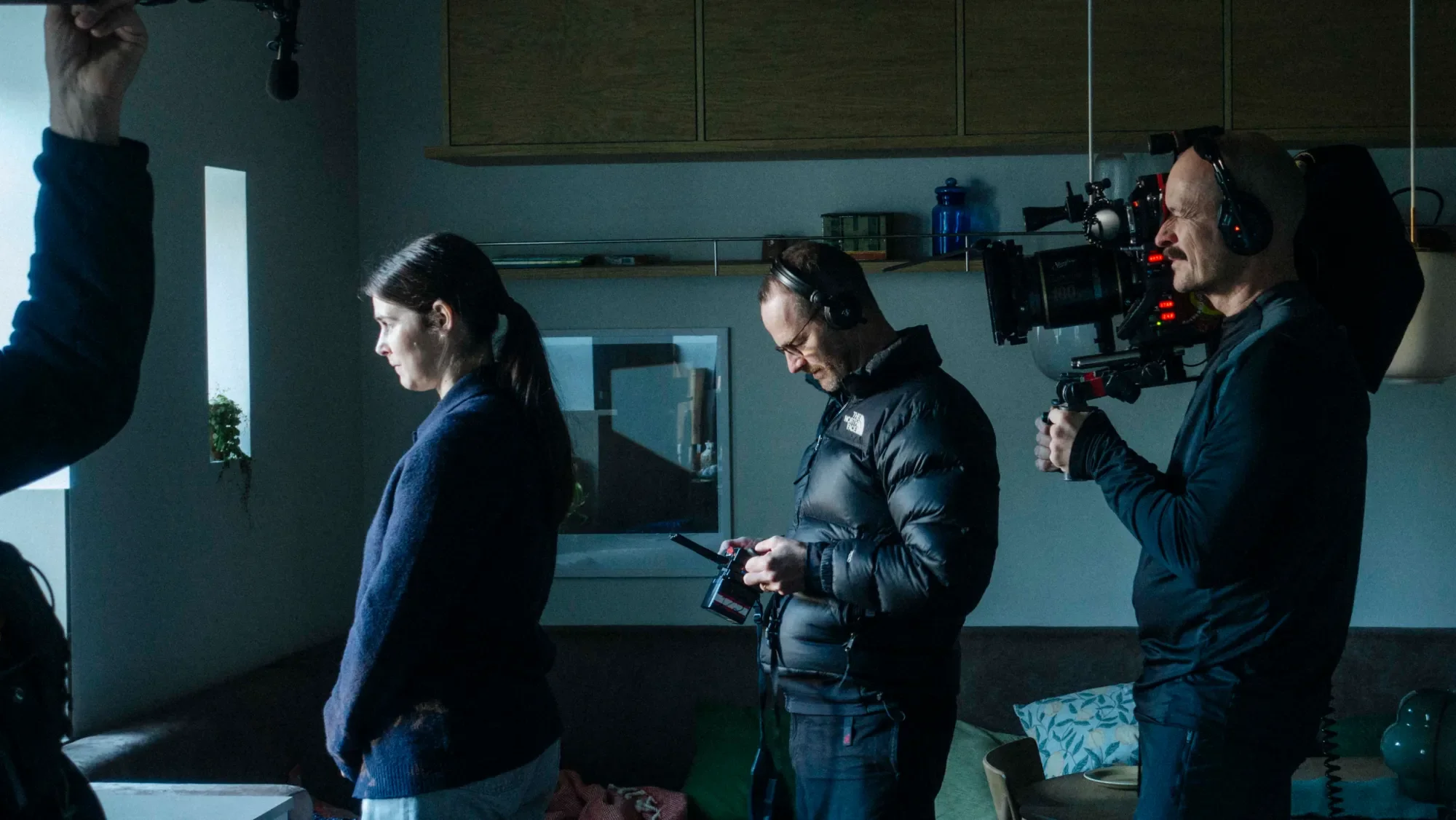
Sentimental Value is almost a weird film for me to watch at this stage of my life. It feels like it is trying to prepare me for fatherhood. The film seemingly touches upon a failed relationship between a father and a daughter. Gustav, a successful film director, played by Stellan Skarsgård, is a classic absent father: he ran away from his ex-wife and two teenage daughters. Years later, he comes back after his ex-wife passed away and tries to reconnect with his daughters, except that his means of reconnection is to cast his older daughter, Nora, in his new, and perhaps, final film. And Nora rejects the idea because he has been absent for their whole lives, and comes back only when he wants to ask something from her. She hates his absent father.
I have been worried about being an absent father, since my original plan was to have my baby raised in China by my parents. Shouldn’t I resist the corruption of patriarchy, in this case, the classic case of the absent father, by putting myself fully into fatherhood?
One of the most beautiful things in Sentimental Value is that big family house that embodies the generational trauma in this family. In this house, Gustav’s mother killed herself when he was 7 years old after two years of torture in prison by the Nazis regime at that time. As a result, Gustav also had a childhood with an absent parent (I don’t remember the story mentioning anything about the father), arguably an even more violent form of absence, which he never talked about out loud. Rather, the subject was touched upon in his films, which the audience knows from Michael, the producer of Gustav in the film. It seems Gustav writes a script based on his mother, but it is actually about his daughter. Eventually, Nora has recognized her father’s effort and heart and decides to star in his film, as a way for them to reconnect.
In Sentimental Value, the absence of a parent is a layered trauma which never heals but regenerates itself in different generations. And the only way for the father and daughter to communicate over the generational trauma is to make a film together. At first, I thought that was beautiful yet so sad: is it so hard for us to open our hearts to our own family? It feels like such a masculine problem that we are so afraid to lose control, that we are trained to be disappointed in ourselves. But later I realized, from a perspective of art as therapy, it is quite common for us to use filmmaking as a way to communicate and heal. In fact, I do it a lot myself: most of my short documentaries are about my relationship with my parents. I have also worked on other projects that helped my friends to re-examine their own relationship to their family.
Coincidentally, another popular film for the award season that I just watched, Hamnet by Chloe Zhao, is also about an absent father making art as a therapy. Originally a novel, Hamnet tells a story about how Shakespeare writes Hamlet to grief over the death of his young son Hamnet. Although a period piece, the story is essentially modern for its acute dissection of gender roles. As usual, Chloe Zhao is incredibly good at revealing the vulnerability in masculinity, their inability to express the raw emotion in a direct, external way. Chloe does not focus on putting blame on the absent father but on the inability of the father to express, revealing how the father silently carries the same weight of grief as the mother. As fate is one of the most prominent components in Shakespeare’s work, Hamnet somehow captures the masculine tragedy as a fate: the inability of expression inevitably pushes the grief deeper, which reversely feeds into the absence, an escape that deepens the inability of expression, a dark cycle that appears as an impenetrable wall as a trait in traditional masculinity. And the only exit is, obviously, art, that blurs the line between public and private expressions of emotion.
I think a lot about my paternal grandfather 周樹華 Shu-hua Zhou, who was emotionally the most distant grandparents of mine. He was an intellectual and underwent public humiliation and wrong accusation in struggle sessions (批鬥大會) during the Cultural Revolution. We have a family history of stroke, meaning we probably have more fragile blood vessels in our brains than normal people. But out of his brothers and sisters who all died of strokes, my grandfather suffered the most: he had 7 strokes in his lifetime and was paralyzed for more than a decade in the final years of his life. I always wonder if that has anything to do with his traumatic experiences during the Cultural Revolution. According to my father, my grandfather has become a very closed-off and silent person. Only after his passing, I became aware of the fact that my family still has the letter of regrets (懺悔書) my grandfather wrote more than half a century ago, in which he was forced to confess to all the false accusations. The worst thing was, what if he was brainwashed to actually believe the accusations were true? Who among his lineage can imagine the amount of shame, pressure, and guilt and struggle he had suffered internally throughout these years? What did he think or feel, or maybe even the act of thinking or feeling had become a taboo for him?
A friend once told me a little bit of the research they read about how trauma can likely be passed down by affecting how the genes are expressed, which they call epigenetics. I think it is hard to say if generational trauma is epigenetical or not, because a child raised by a traumatized parent can present similar symptoms, and that is very difficult to quantify for a scientific conclusion.
I also think about my maternal grandparents, 蘇慰如 Wei-ru Su and 黃和香 He-xiang Huang, who went through famine when they were kids (around 1930s-40s in China). They were forced to move, becoming homeless and wandering migrants from town to town. They are also likely the last generation of Chinese who are illiterate, which has stripped them away from all the opportunities of learning any technologies, knowledge, and perspective. Ever since I knew them, they never seemed to think about anything else other than being able to feed themselves. The stories they told me always started with “in the past, there was no food. It was miserable”. Even though now we live in a peaceful time and their children are well off and able to provide, it always feels like my grandparents are still living a lifestyle as if they were surviving. Either my parents or I were raised being told that eating is the most important thing in life. I always suspect that the historical trauma in the modern history of China is a part of the reason why food and eating play such an essential role in Chinese culture today (maybe we are changed epigenetically so we feel stronger joy toward food, due to the past century of memory of hunger)?
This summer, I watched Jafar Panahi’s new film, It Was Just An Accident. I have less emotional attachment to this film, but it provoked some thoughts in me that I never found a chance to write about. And somehow, both these films touch upon a similar topic, that is how we interact with historical trauma. Under the facade of a genre dark comedy, the question It Was Just An Accident presents is darker, more saddening yet poignant: even if the dark time has passed, can we afford to forget and move on to a good life, or will the trauma inevitably become our source of purpose, identity and meaning, something that we must hold on to live on (hard to imagine anyone else can access this topic with such lightness and grace)? If one generation has taken their historical trauma as their core identity, it is hard not for the next generation to hold onto it.
I am obsessed with this song in Rosalia’s new album, where she sings almost like whispering “mio Cristo piange diamenti”: my Christ cries diamonds. I am struck by the beautiful vision in this song where human suffering can be seen as treasurable and sacred. My friend Mimi and I had a discussion a long time ago: we agreed that it is not a bad thing for humans to undergo a certain amount of trauma, for that is what gives us purpose and meaning in life, as long as the trauma doesn't destroy us. As generations continue, the trauma is inevitably diluted. Although I can’t imagine what my grandparents really felt and thought at that time, I also cannot imagine what I would be without the strength and perspective that history has given me. I sometimes even feel like I am a thief, effortlessly harvesting from the dark memories of my ancestors.
This essay is meant to be about movies, not about me having a baby. But inevitably, it is redefining me more than I would expect. It is hard not to re-examine the trauma in my family history when I am mentally preparing to have a child: what did I get from my ancestors, and what will I pass down to my son, 樂原 Le-yuan (to say “my son” out loud has the same weird feelings almost as to acknowledging death, in a sense that they are the most violent reality shift)? Sentimental Value feels weirdly timely for my life, for it not only inspires me to think more about what kind of father I want to be, but also what I am and what has shaped me. And there is nothing more beautiful than how close we can connect to a film so personally.