Miraculous Cinema
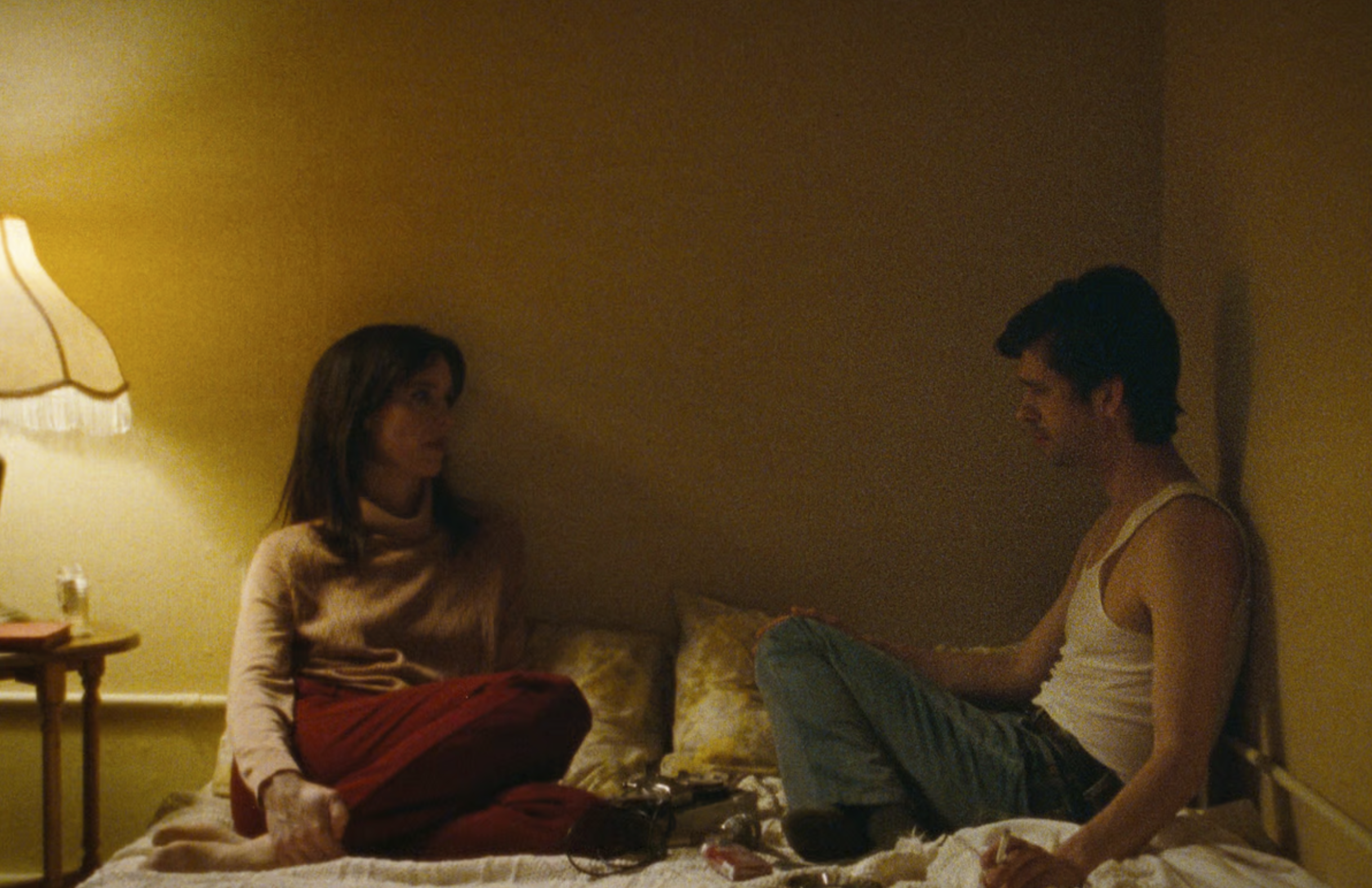
When I fall in love with someone, often I would find myself lost simply looking at his face, especially when asleep. The pores on his skin, every single mole, maybe the acne, every single hair, every wrinkle, every single subtle movement of his face—whether expressive or not—can become the most beautiful thing, something my eyes never tire of. I cannot imagine the stories and time that gave birth to that face, but at that time, at that place, when I look, it is beautiful simply only because it exists. And it is the same kind of beauty in Peter Hujar’s Day.
In an interview at the New York Film Festival, director Ira Sachs said “I wanted to make a film about pleasure, and I didn’t want to make a film about truth”. Meanwhile, in the film, Ben Whishaw and Rebecca Hall reenact the dialogue between Peter Hujar and Linda Rosenkrantz in a word-by-word way. These two gestures may seem contradictory. Yet one of the most fascinating powers in cinema lies precisely in this misalignment between the past—or “reality”, if one wishes to call it that—and its representation, a dream realm where we can experience simultaneously absolute nowness and the flow of our secular time, a fleeting illusion through which we can briefly access immortality. Perhaps this is the pleasure to which Ira Sachs refers.
The original conversation happened within a day, continuously, at a table. Ira Sachs fragments this conversation across different spaces and non-chronological times within the apartment: from morning to sunset, sunset to nighttime, from the dining table to the kitchen, from the kitchen to the bedroom and so on. The misalignment and dream-like quality are achieved mostly by the intermittence Ira Sachs brought into the film. What enhances such intermittence further is the constantly changing wardrobes of Ben and Rebecca. Dimly lit and subtly blocked, the film ends up being a montage of beautiful portraits led by this word-by-word reenactment of the conversation. Expecting a continuous dialogue, it caught me off guard in the theater. The intermittence perhaps serves more as jump cuts, teleporting the characters through space and time. And 16mm film is a perfect medium for this teleportation. The strong texture of grain and softness brings fluidity and wetness to the viewing sensation. While sitting in the dark theater, I can’t help imagining the images of the real conversation between Peter and Linda, and the images in this film, overlapping them with each other: on the lining remembering and forgetting (Chris Marker), I was in a dream.
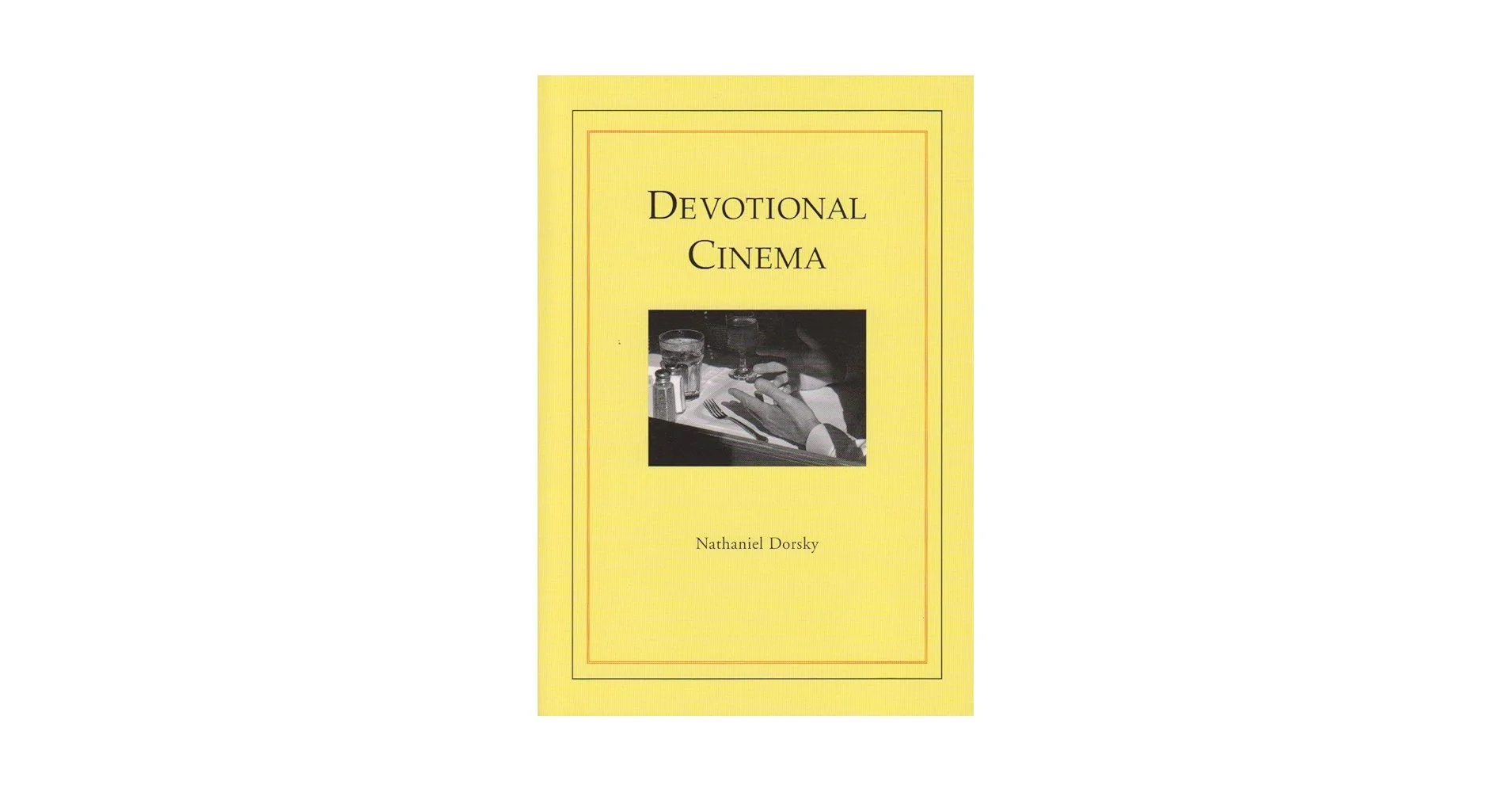
Devotional Cinema by Nathaniel Dorsky
While writing this essay, I revisit Nathaniel Dorsky’s little book Devotional Cinema, one of my favorite writings about cinema. On a now seemingly defunct movie blog Daily Plastic (what a great name), the film critic Robert Davis mentioned that Dorsky spoke about preventing his work from “collapsing into meaning”. Dorsky is very cautious about our modern instinct to pursue “meaning”, for “meaning” is a conclusion, which brings an end to looking into the unknown: it compresses and flattens everything for quick consumption, rather than allowing us to fully experience its materiality, form, and verticality, and hence we lose the ability to appreciate (beautifully resonating with Byung-chul Han’s idea of love and the other). I think this is probably the reason why I fell in love with Peter Hujar’s Day. It is an experiment, from Ira Sach’s own words. The film focuses on the materiality of only the key components of film: pure human interactions and emotions, the lighting and blocking, the wardrobe, the grain, the texture, the cuts, the time and space it tries to recreate…There are no apparent plots, conflicts or any meaning to distract you from fully immersing yourself in this dream realm in the dark theater.
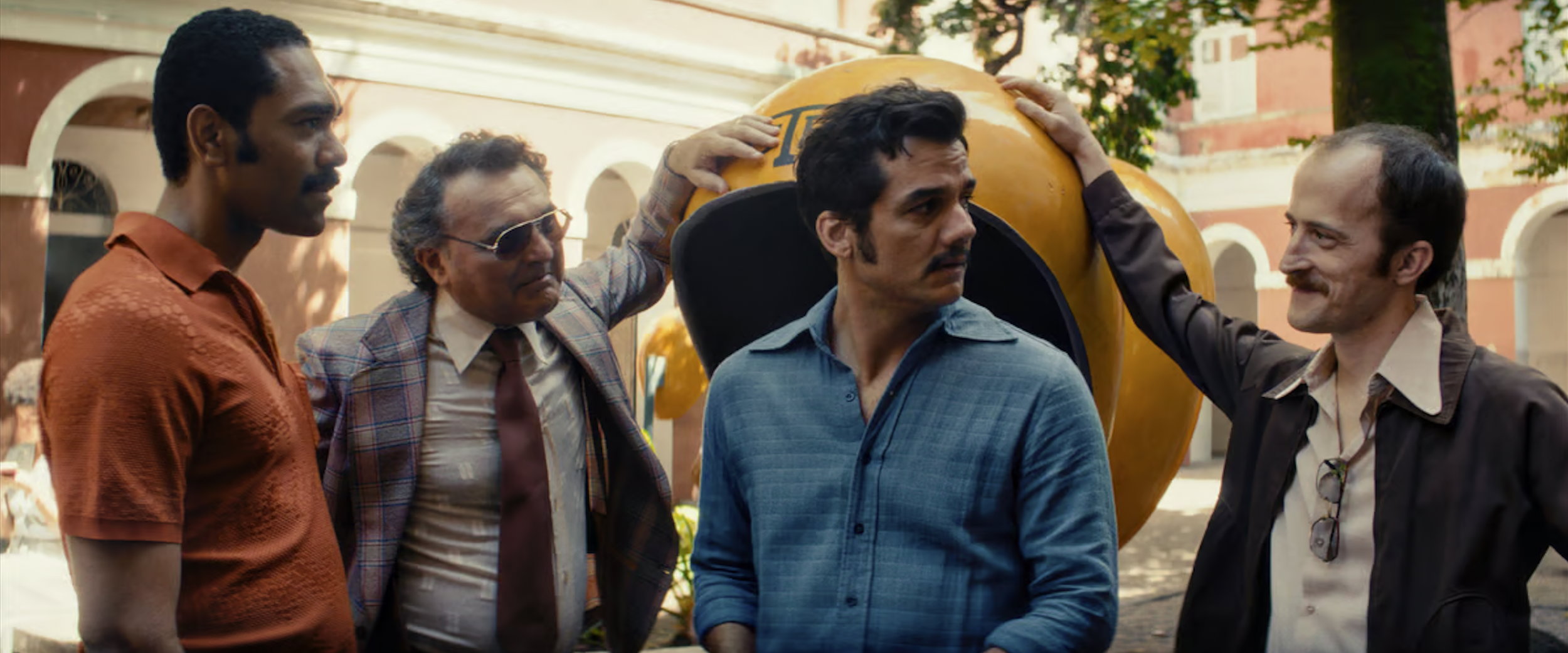
Screenshot of The Secret Agent
Another film that I have appreciated for similar quality lately, is The Secret Agent by the great Brazilian director Kleber Mendonça Filho. The first time I watched it, it felt confusing because at first the film was marketed as a genre film: thriller, crime, spy, drama. As it unfolds, however, its conflicts and plots remain understated, or veiled. Instead, the film brings forward a constellation of multifaceted characters who do not seem to push the story ahead, along with an abundance of meticulously rendered mise-en-scènes of that period, the 70s in Recife, Brazil, Kleber’s hometown. Every single character in the film seems to have something to say, and every single object in the film seems to have some untold story, but none of those is related to the main story. Or perhaps the question is: what is the main story at all? I remained confused but deeply intrigued for its rich materiality, until the very end – one of those most powerful but subtle endings that leaves you suspended in thoughts and feeling – when the film finally revealed its true self and purpose: a resurrection of the memory and history of that that time and place, and also, a never-enough love letter to the cinema. Even the genre itself, essentially a disguise, is a tribute to cinema itself that is not necessarily tailored for what the film is: the form itself is also a part of the story. But The Secret Agent is also more than just its materiality. Kleber skillfully disrupts the linear flow of time and turns the object into the subject. It is the seer but also the seen, a contemplation on how we see or connect to the past, even a past that is lost, forgotten but can be so intimate to our heart of being, which is also a reference to cinema itself as a time machine. There is an amazing interview on Filmmaker Magazine where he spoke about some context in this film. And I strongly recommend reading this interview because the context really changes your understanding of what he tries to do for certain scenes.
The pessimism in representation is a tradition throughout the history of human beings. In Republic, Plato wrote about the famous allegory of the cave, where we humans live in a cave and mistake the shadow on the wall for the real world. Cinema is in many ways, a near-perfect incarnation of Plato’s allegory: people watching shadows in a dark cave to understand the outside world. I am undoubtedly in love with “the real world”, every sound I can hear, every texture I can touch, every light that I can see. But in other words, we are also trapped in our own bodies, our senses. We are born and die but we never understand why or how. To put it in Dorsky’s way, it is a situation that we simply just participate in and are in awe of. Humanity’s curse is that we don’t just exist in “the real world”, what’s more, we are conscious and we remember. We inhabit a realm of memory and dream that exceeds tangibility, compelling us to continually question the nature of our situation. I have a tattoo on my arm of the word simulacra, from Jean Baudrillard’s interpretation of hypereality, that in modern day, the world of reality is only a limbo of perceptions. Lately, however, I have begun to think that hyperreality may have existed long before post-modernism—not as a refuge from reality, as it often functions today, but as an open question.
Just like writing, music or any other art form, cinema is capable of capturing something true that is not necessarily tangible to our biological senses but something in the context of history, memory and time. As a medium we see the world through, it has been carrying human experiences and memory through distance and time, beyond our own birth and death.
I think about my child who is still inside Anika’s belly: does he have consciousness? It is a fact that none of us has a memory of being inside our mother’s womb. But if we are comfortable with such a fact where we didn’t use to exist and we also have no memories of our non-exsistence, why should we be afraid of death, where we no longer exist? We essentially travel from non-existence to another. If we want to believe the world is bigger, and life is bigger than our fragile, short-lived physical body, there is no reason to reject hyperreality, the world of representation. After all, is it a miracle that we can read Plato’s mind from 2300 years ago, or see the face of Nanook of the Inuit from more than 100 years ago?